For any industrial facility, maintaining operations requires a careful balance of productivity, profitability and responsibility. A critical component of this responsibility is ensuring environmental compliance. Adhering to air quality regulations is a fundamental requirement for doing business. Government bodies, guided by regulations like the Clean Air Act, set enforceable limits on emissions to safeguard public health and the environment.
Investing in effective air pollution control technology is a proactive strategy for ensuring operational continuity and long-term sustainability. Among the most reliable and effective technologies for this task is the wet scrubber.
Understanding Wet Scrubber Applications
A wet scrubber is an air pollution control device designed to remove harmful pollutants from industrial exhaust streams or flue gas. The basic mechanism is straightforward yet highly effective. The contaminated gas makes contact with a scrubbing liquid. Through absorption, chemical reaction or neutralization, the liquid captures or transforms the pollutants, allowing the release of clean air into the atmosphere.
The versatility of a wet scrubber makes it indispensable across numerous applications. Their primary uses include:
- Acid gas removal: Scrubbers neutralize acidic gases like sulfur dioxide (SO₂), hydrogen chloride (HCl) and hydrogen sulfide (H₂S).
- Particulate matter capture: A scrubber helps maintain industrial air pollution control by removing dust, soot and other particulates from the gas stream.
- Odor control: Wet scrubbers can eliminate foul-smelling compounds often found in wastewater treatment, chemical processing and food production.
- Hazardous air pollutant (HAP) control: Use scrubbers to treat toxic compounds such as ammonia (NH₃), chromic acid and certain volatile organic compounds (VOCs).
The effectiveness of a wet scrubber lies in its ability to allow users to tailor it to a specific gas stream. Depending on the target pollutant, the scrubbing liquid can be water, a reagent solution or a slurry. This adaptability is why packed bed scrubber systems, which maximize contact between the gas and the liquid, are a go-to solution for treating a wide array of harmful emissions.
The Role of Wet Scrubbers in Meeting Environmental Compliance Standards
The Environmental Protection Agency (EPA) establishes technology-based standards, such as Maximum Achievable Control Technology (MACT), to dictate the level of emissions reduction required for major sources. Wet scrubbers are a primary compliance technology used to achieve the rigorous numerical limits defined by the National Emission Standards for Hazardous Air Pollutants (NESHAP) and National Ambient Air Quality Standards (NAAQS).
The performance of wet scrubbers in meeting these standards is well-documented. According to an EPA technology fact sheet, properly designed wet scrubbers can achieve removal efficiencies of over 90%, with certain configurations reaching up to 98% for pollutants like SO₂. This high level of efficiency provides plant operators with the confidence that their facility can comply with a wide range of air pollution control regulations.
A scrubber’s ability to meet these strict standards depends on several critical engineering factors working in harmony. The choice of scrubbing liquid, for example, must be matched to the pollutant for effective neutralization. Furthermore, the scrubber’s internal design, particularly the type and depth of the tower packing, should be engineered to maximize contact time between the gas and the liquid.
Factors like liquid-to-gas ratio, operational temperature and pH control of the scrubbing solution are continuously managed to ensure the system operates at peak efficiency, providing reliable and consistent compliance with all regulatory requirements.
Why Trust MACH Engineering for Your Compliance Needs?
Achieving long-term environmental compliance demands a partnership with engineering experts who understand the nuances of your industrial processes. At MACH Engineering, we don’t provide one-size-fits-all products. We deliver guaranteed performance through quality engineering and custom wet scrubber systems tailored to your specific application. Our process begins with a deep dive into your operational needs, from pollutant composition and gas flow rates to your facility’s physical footprint.
Our capabilities include designing and delivering a system built for performance, longevity and reliability. Whether complying with complex chemical plant environmental regulations or large-scale oil and gas refinery standards, our systems come with a process guarantee to protect your operations.
We select the ideal construction materials and packing media to ensure your equipment withstands harsh conditions while consistently meeting and exceeding the required emission standards. With MACH Engineering, you get a solution engineered for peace of mind.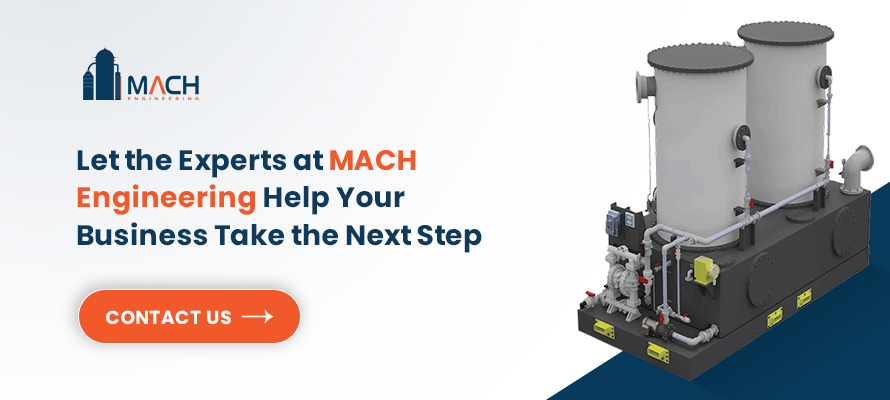
Contact MACH Engineering to Learn More Today
A wet scrubber is a critical asset that ensures your facility can operate cleanly, safely and without interruption. By investing in a proven air pollution control technology, you are actively protecting your business from the significant financial and reputational risks of noncompliance.
Are you ready to ensure your facility meets and exceeds environmental standards? Let the experts at MACH Engineering help your business take the next step.
Contact us today to discuss your business’s specific application. We’ll help your organization get a scrubber solution for environmental compliance and performance.
