

Choosing the appropriate scrubber construction material for a vessel and its components is key to ensuring a long service life. At MACH Engineering, we custom fabricate internals to meet the demands of your process. Learn more about how to choose a suitable material for your organization’s needs.
The Importance of Choosing the Right Materials
 Suitable materials can help avoid the extra time and costs associated with vent scrubber maintenance downtime. Improper selection of materials can lead to corrosion, deterioration, maintenance, downtime, regulatory noncompliance and fines. The right materials ensure your equipment lasts longer and works more efficiently for your operations.
Consider the maintenance MACH conducted on a scrubber to illustrate this point. During the maintenance period of one of the vent scrubbers, MACH proposed replacing Monel Internals with the TEFLON™/PTFE Internals based on the process conditions.
Monel 400 is a nickel-copper alloy. It is resistant to corrosion caused by acid, alkali and seawater. Thus, it is widely used in the construction of environmental plants, where vessels and components are exposed to acids such as sulfuric acid and hydrofluoric acid. However, its ability to withstand corrosion becomes limited in the realm of nitrous acid, nitric oxide, sulfur dioxide and hypochlorite. After examination of the Monel internals, it became clear that Monel did not perform well under the conditions inside the tower.
 PTFE offers superior chemical resistance and broad temperature stability, while Monel provides greater mechanical strength and structural integrity. PTFE’s properties remain useful over a wide temperature range of -100°F to 400°F, resulting in a long service life and low maintenance cost.
Along with internals, 12’’ MONTZ Structured Packing, previously installed in this scrubber, was replaced with 1’’ Tri-Packs in PFA. The latter is a type of random packing commonly used in mass transfer applications. 1’’ Tri-Packs are less expensive and offer a similar low-pressure drop compared to structured packing and a reasonable percent flooding based on the process data.

Tower Packing Media Selection
The right tower packing material will reduce the risk of leaks, structural damage and environmental risks. You’ll find various materials that can meet the specific needs of your organization’s vessel and ensure long-term operational reliability.
Common materials for scrubber construction and components include:
Polypropylene

Polypropylene media can enhance the efficiency of the water treatment process. MACH polypropylene Hi-Rings are used in oil and gas, chemical, alkali chloride and environmental applications. They provide low specific gravity, high mechanical strength and large void space.
However, polypropylene may not withstand extreme temperatures or mechanical stress, making it crucial to get the proper construction material for your specific industrial process.
Ceramic
Ceramic packing offers high thermal and chemical resistance and durability in harsh environments. The packing material can help reduce pressure drops when handling high liquid and gas flows. Ceramic saddles offer a wide surface area, improving mass transfer and efficiency at a lower price point.
Often, pre-fired ceramic bricks cover the organic linings in venturi throats. However, they can be brittle and shatter under mechanical stress, leading to unexpected downtime and safety concerns if not used correctly. Overall, ceramic materials are ideal for specialized applications for their resistance to high temperatures and certain aggressive chemicals.
Stainless Steel
Stainless steel components like trays, plates, fasteners and supports have been used in many absorbers due to their corrosion resistance and excellent performance in high-temperature applications. High chloride levels can cause corrosion, and abrasion from the scrubber slurries can lead to wear failures. Businesses must choose the right type of steel alloy, as the incorrect option can result in corrosion or brittleness, leading to frequent maintenance and downtime.
Fiberglass Reinforced Plastic
Fiberglass reinforced plastic (FRP) with vinyl ester resin is ideal when the scrubber handles corrosive, wet gases or condensation. Common applications include acid or corrosive-fume and odor-control systems. Businesses often find that fiberglass reinforced plastic works well in situations where chemical exhaust streams are known to create acidic liquids once they make contact with water. The material is widely used in scrubber tower bodies, ducting, sumps and supports as a result.
FRP offers corrosion resistance without rust, an extended life in wet service and lightweight construction for easier installation. The material resists acids, alkalis and chlorinated compounds. Standard FRP with vinyl ester resin often handles temperatures from -40°F to 200°F. Pressure/vacuum capability is design-specific; many ASME RTP-1 FRP vessels are built for full vacuum through about 15 psig rather than high internal pressure. Dual-laminate FRP combines fiberglass wet scrubbers with thermoplastic liners for enhanced chemical protection, handling temperatures up to 280°F, depending on liner selection.
Tower Internals Selection
Tower internals can provide uniform distribution within the packed bed while accounting for process factors such as fouling and foaming. MACH offers tower internals in various styles and materials, including:
- Exotic alloys and ceramics
- Graphite
- Plastics
- Stainless steel
Using the right tower internals for your business’s specific application can help optimize performance in new or existing towers.
Structural Material Selection
Structured packing materials offer more efficiency and lower pressure drops than random packings or trays. MACH uses the following materials to construct wet scrubber systems:
- Stainless steel
- Titanium
- Polypropylene/polyethylene
- Fiberglass reinforced plastics
Why Trust MACH Engineering for Material Selection?
MACH Engineering specializes in the custom fabrication of tower internals and wet scrubber systems, using appropriate materials for packed bed scrubber applications. Our process engineers analyze operating conditions to recommend the best material of construction, whether a business needs stainless steel wet scrubbers, plastic wet scrubbers or fiberglass solutions.
We help organizations determine what materials are effective for wet scrubbers based on environmental temperature, pressure and chemical exposure requirements. Different from competitors, our team keeps industrial processes under one roof. Companies can rely on a single point of contact for assistance with both tower pack media selection and equipment design. We design the products our clients need for success and consider a facility’s unique use cases before completing the sales process.
Our professionals have been working with clients for over 25 years. When a business chooses MACH Engineering, they get a partner who offers premium material quality at economical prices.
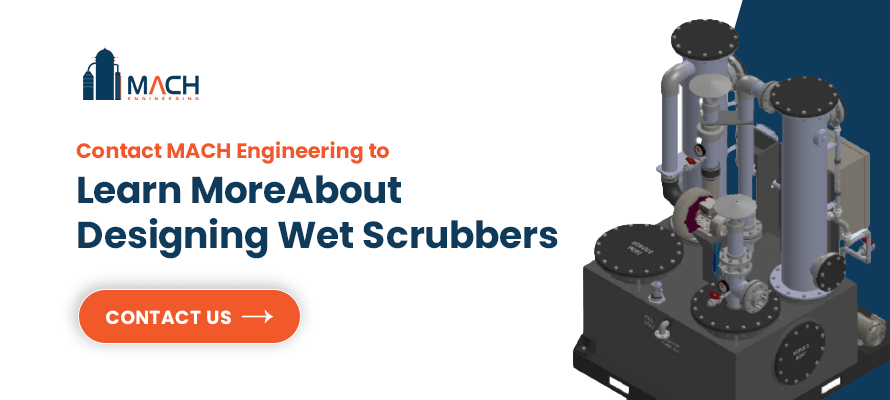
Contact MACH Engineering to Learn More About Designing Wet Scrubbers
While designing new systems or revamping less efficient separation units, it is imperative to analyze organizational process data and other requirements. A proper understanding of these specifications helps businesses select the right equipment and construction material to make high-performance units.
At MACH Engineering, we can design the products that best fit specific operational needs. That way, businesses can avoid downtime and its associated costs.
To learn more about designing wet scrubbers for a facility, contact us today.
