Meeting discharge permits while minimizing energy costs can be challenging. Air strippers can effectively remove volatile contaminants and certain dissolved gases, helping your business meet regulatory limits for wastewater stripping and discharge. This guide to air stripping explores the process and covers the key design factors.
What Is Air Stripping and Why It Matters
Air stripping is a mass transfer process that moves volatile organic compounds (VOCs) from liquid to gas, removing contaminants from wastewater.
Wastewater and groundwater regulations are tightening. In April 2024, the U.S. Environmental Protection Agency (EPA) announced the first-ever national drinking water standards for PFAS. While activated carbon and ion exchange are typically used to treat PFAS, air stripping also plays a role. The air stripping step of the treatment train cleans up VOCs and precursors, enabling better overall PFAS removal for the system.
Stricter 2024 Effluent Limitation Guidelines (ELGs) for power plants require a robust treatment train to reach zero-discharge goals. Air stripping plays a vital indirect role by removing ammonia that would otherwise compromise biological reactors and zero liquid discharge (ZLD) evaporators. This pre-treatment ensures that systems capturing mercury, arsenic and selenium can operate efficiently without interference from nitrogen-based compounds.
Air stripping can be more economical for certain applications than alternative methods, such as liquid-phase carbon adsorption, when dealing with high-flow, volatile contaminants. This includes chemicals such as ammonia (NH3), BTEX, trichloroethylene (TCE) and trihalomethanes (THMs). Many of these, including TCE, are treated with air stripping at sites monitored by the Office of Land and Emergency Management, such as the North Indian Bend Wash Superfund site in Arizona.
The Science: Henry’s Law and Treatability
Understanding how air stripping works is key to finding an effective system for the chemicals your organization needs to control.
Henry’s Law Constant (H) measures how easily a compound moves from water to air. The higher the H value, the more the chemical wants to go into the air, making it easy to strip. An example is vinyl chloride. In contrast, a low H value, like in phenols, means the chemical wants to stay dissolved in the water. This makes these compounds less practical to strip.
Three key variables affect the air stripping process, including:
- Temperature: Heating the wastewater increases the volatility of the chemicals, making stripping more efficient.
- Pressure: Most air strippers operate at atmospheric pressure levels because higher pressures increase gas solubility in the water. This makes it more difficult to strip contaminants into the air stream.
- pH: Some chemicals need a specific pH to strip effectively. Ammonia needs a high pH to strip, whereas hydrogen sulfide needs a low pH. For other VOCs, pH isn’t as crucial.
System Types: Packed Towers vs. Sieve Trays
Packed towers and sieve trays are two of the most common types of air strippers.
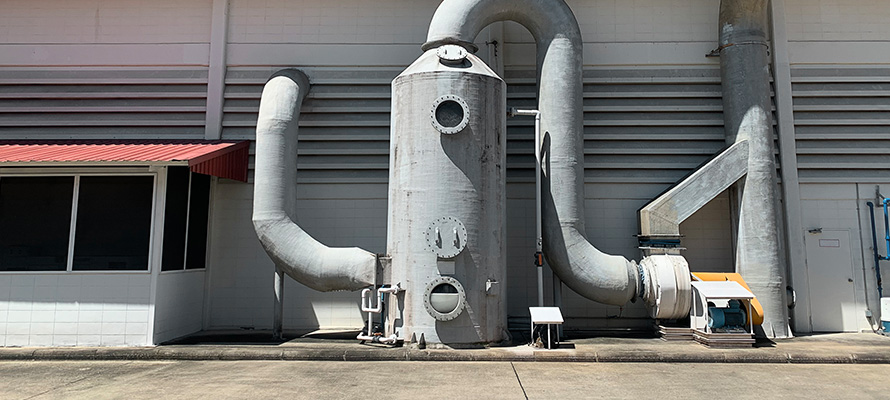
Packed tower air strippers are vertical columns, ranging from 5-12 meters tall, filled with plastic, metal or ceramic packings. Wastewater flows down through the packings while air is forced up, mixing and removing contaminants.
An air stripping tower can have a very high removal efficiency of more than 99% for certain contaminants and can handle high water flow rates exceeding 100 GPM.
The drawbacks of packed tower air strippers are their taller profile, which may not suit restricted spaces. Fouling from suspended solids, biological growth and scale poses a key issue. Another consideration is dealing with the contaminants once they’re out of the water and into the air, using techniques like off-gas treatment.
Sieve trays use multiple trays with perforated holes. These have a lower profile and are easier to clean and inspect. They tend to have lower efficiency per stage. Sieve trays also have a limited turndown ratio, which means they are less flexible if the water pressure drops too low.
The Role of Tower Packing and Internals
Efficient tower air stripping depends on proper internals, such as packings and distributors.
Packings can be structured or random. A key advantage of random packing is its versatility in balancing high surface area with hydraulic capacity. By selecting the optimal shape, size and material, you can customize a solution that maximizes contaminant removal while maintaining efficient flow rates for your application.
The key trade-off to consider is between surface area and pressure drop. The higher the surface area, the more contact between the water and air, allowing more stripping. Conventional packings, such as ceramic saddles, typically have a large surface area, but they block airflow, causing a higher pressure drop.
Modern packings, such as MACH Tri-Packs, provide a solution to this. These sphere-shaped random packing media create a large surface area with lots of tiny ribs and struts, which makes separating chemicals more efficient.
Another advantage of the MACH Tri-Packs is that their open, sphere-shaped design consists mostly of air. This allows fluids to pass through with minimal resistance, preventing nesting and reducing pressure drop compared to traditional packings like ceramic saddles. In combination with the large surface area, Tri-Packs provide the power of small packings with the energy savings of big packings.
Liquid distributors also play a key role in air stripping towers. Uniform distribution prevents channeling and maximizes the performance of your air stripper. Gravity distributors may be better suited for high flow rates compared to pressure distributors.
Another key component of a tower air stripper is the mist eliminators. These prevent water droplets from exiting the top of the tower.
Engineering Design and Sizing Considerations
When designing the most efficient air stripper, consider these factors:
- Influent flow rate: It is key to know how much water the system needs to handle.
- Influent concentration vs. target effluent: Specify the required chemical reduction to meet standards. For example, reduce ammonia concentration from 100 ppm to 1 ppm.
- Water temperature: With higher temperatures, a shorter tower may be enough to treat the water to an acceptable level. Colder temperatures may need a higher tower to strip the chemicals effectively.
- Air-to-water ratio: The air-to-water ratio determines the size of the blower you need to air strip efficiently. Typical ratios are 50:1 or 100:1.
- Column diameter vs. height: Wider towers cater for higher flow rates and prevent flooding. Taller towers are best suited for contaminants that need more contact time.
Benefits
Air strippers have many benefits over alternative systems, including:

- Low operating expenses: Air strippers are more economical for some applications. For example, they are more cost-effective than replacing carbon filters.
- Robust: Compared to biological treatment plants, which can experience toxic shock from sudden ammonia spikes, air strippers are physical systems that can better handle fluctuating concentrations.
- Space-efficient: The height of the towers can save floor space compared to trays.
- Fewer chemicals: Some VOC stripping applications primarily use air and electricity, reducing the need to buy, store and handle hazardous chemical oxidizers.
Applications
These benefits make air strippers suitable for many applications across different industries, including:
- Treating municipal water by removing THMs and radon.
- Removing petrochemical, pharmaceutical and textile effluents from wastewater.
- Remediating groundwater by eliminating solvents in pump-and-treat systems.
Why Trust MACH Engineering for Mass Transfer Solutions?
At MACH Engineering, we are mass transfer specialists who understand the core science behind air stripping. We can calculate the height of a transfer unit and flooding percentages to ensure your company’s tower performs in the real world, not just on a spreadsheet. Our calculations also allow us to provide the most efficient components for the system.
We use advanced process simulation software to model our clients’ needs. By analyzing the flow rate, temperature and contaminant mix, we can optimize processes and solve bottlenecks. These simulations also enable us to ensure that our recommended packing height or diameter meets your organization’s effluent targets.
Since 2005, we have served a range of industries from water and wastewater to petrochemicals and manufacturing, helping our customers stay compliant and meet strict discharge limits.

Find Dependable Air Stripping Solutions at MACH Engineering
Successful wastewater stripping relies on the robust engineering of stripping systems according to Henry’s Law. Working with experienced engineers to test and design air stripping solutions is crucial to ensure an efficient process.
Whether you need to retrofit your existing air stripping system or need a total overhaul, call MACH Engineering at 281-688-2998 or fill out a form.
